
Inspire Innovations international limited.
Type the part number or keyword in the search box. If you do not know the catalog number, you can find the product by category or by manufacturer. To find a product by device model, first select the manufacturer.
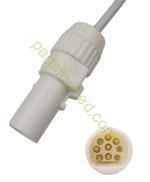
Reusable adult ear clip SpO2 Sensor for M&B patient monitors
$78
Found cheaper?
-
+
Buy in 1 click
Consult in WhatsApp 
The price is valid only for the online store and may differ from the prices in retail stores.
Description
Reusable adult ear clip SpO2 Sensor for M&B patient monitors
Part number U417-1HL
adult (more than 40 kg),
clip type - "ear clip",
wire length - 3 m,
connector - 7 Pin
Reusable pulse oximeter sensor is designed to measure the level of saturation (oxygen saturation) of the patient's blood.
### Technical Overview: Reusable Adult Ear Clip SpO2 Sensor #### Introduction Pulse oximetry is a non-invasive method employed widely to monitor the oxygen saturation (SpO2) of a patient's blood. Among the various types of sensors used, the reusable adult ear clip SpO2 sensor stands out for its convenience, durability, and accuracy. This document provides a detailed technical analysis of the reusable adult ear clip SpO2 sensor, focusing on its design, functionality, applications, and maintenance. #### Design and Construction The reusable adult ear clip SpO2 sensor is typically designed to provide a secure and comfortable fit on the earlobe, ensuring reliable readings during a range of activities. Key components include: 1. **Sensor Housing**: Made from durable, hypoallergenic materials, the housing is designed to minimize discomfort and maximize durability and user safety. The clip component ensures that the sensor maintains firm contact with the earlobe without causing excessive pressure or discomfort. 2. **Light Emitting Diodes (LEDs)**: The sensor contains two LEDs, usually red (660 nm wavelength) and infrared (940 nm wavelength). These wavelengths are chosen because they are selectively absorbed by oxyhemoglobin and deoxyhemoglobin, respectively. 3. **Photodetector**: Positioned opposite the LEDs, the photodetector measures the intensity of light that has passed through the earlobe. By assessing the differences in absorption at the two wavelengths, the sensor can calculate the oxygen saturation level of the blood. 4. **Cable and Connector**: A flexible, shielded cable connects the sensor to the pulse oximeter device. The cable is designed to minimize signal interference and physical wear. The connector is typically a keyed plug to prevent misconnection. #### Functionality The reusable adult ear clip SpO2 sensor operates on the principle of photoplethysmography. Key operational features include: 1. **Signal Acquisition**: The LEDs emit light through the earlobe. As blood pulses through the earlobe, it modulates the transmitted light at each wavelength, which is detected by the photodetector. 2. **Signal Processing**: The detected signals are processed to separate the pulsatile component (arterial blood) from the non-pulsatile components (venous blood, tissues). Advanced filtering techniques are used to enhance signal quality and reduce artifacts due to motion or ambient light. 3. **Calculation of SpO2**: The ratio of the absorbance at the two wavelengths is used to derive the SpO2 value. Most sensors utilize proprietary algorithms to improve accuracy across a range of physiological conditions and skin tones. 4. **Data Transmission**: The processed signal is sent to the pulse oximeter device, where it is displayed to the user. Some sensors may include features for wireless transmission or integration with electronic health records (EHR) systems. #### Applications The reusable adult ear clip SpO2 sensor is used in various clinical settings, including: 1. **Hospitals and Clinics**: For continuous monitoring of oxygen saturation in critically ill patients, during surgeries, or in recovery rooms. 2. **Home Healthcare**: For chronic disease management, particularly in patients with respiratory or cardiovascular conditions. 3. **Exercise Physiology**: For monitoring physiological responses in athletes during training. 4. **Sleep Studies**: In polysomnography to assess oxygen saturation levels during sleep. #### Maintenance and Calibration To ensure accurate and reliable performance, proper maintenance and regular calibration of the reusable adult ear clip SpO2 sensor are essential: 1. **Cleaning**: After each use, the sensor should be cleaned with a mild disinfectant solution. Care should be taken not to immerse the sensor in liquid or use abrasive cleaners that might damage the LEDs or photodetector. 2. **Inspection**: Regular inspection for physical damage, wear and tear, and proper functioning of the clip mechanism is necessary. 3. **Calibration**: Though most modern sensors are factory-calibrated and require minimal recalibration, periodic checks against a reference device are recommended. Some models may have software-based calibration features. 4. **Storage**: Store the sensor in a clean, dry place, away from direct sunlight, and at a temperature range specified by the manufacturer to prevent any degradation of the optical components. #### Conclusion The reusable adult ear clip SpO2 sensor is a vital tool in modern medical and health monitoring applications. Its ability to deliver continuous, non-invasive, and highly accurate measurements of blood oxygen levels makes it indispensable in various healthcare settings. Proper use and maintenance can significantly extend the sensor's lifespan, ensuring sustained performance and reliable patient monitoring.Ask a Question